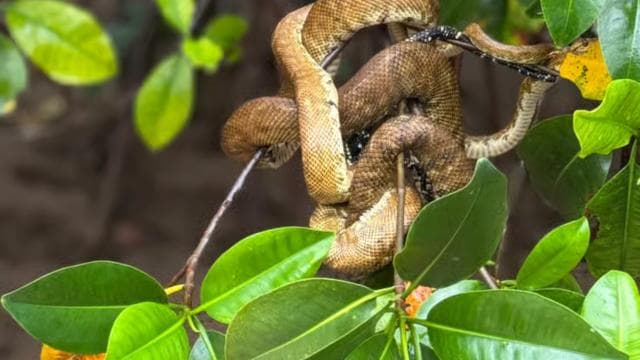
Mangrove Experience from Uvita
5.0(96)
From$135
Mangrove Experience from Uvita
5.0 (96)
From$135per person
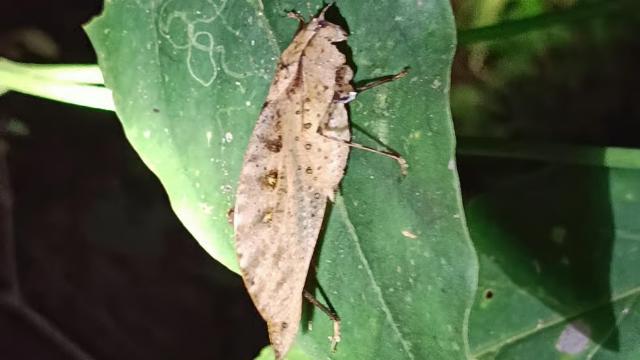
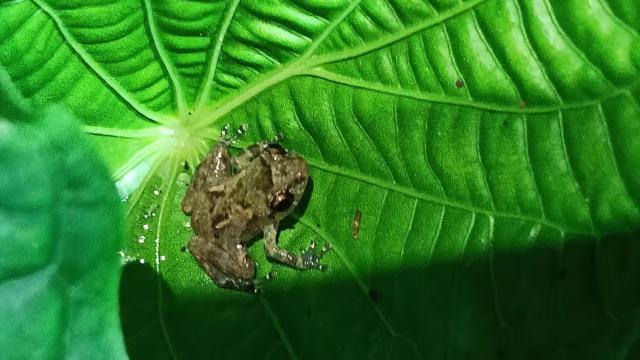
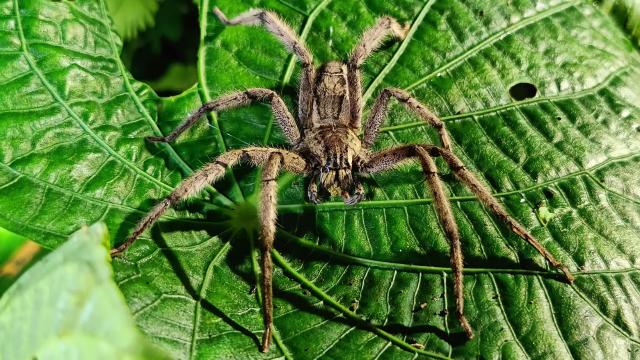
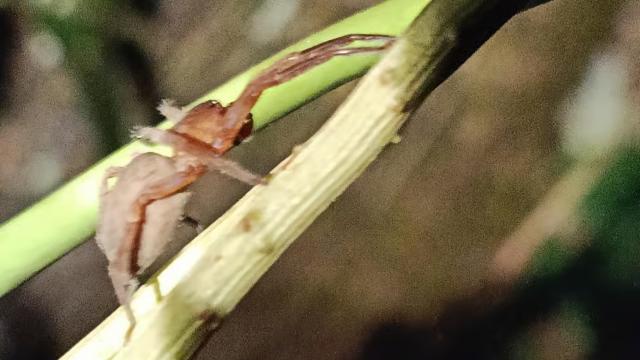
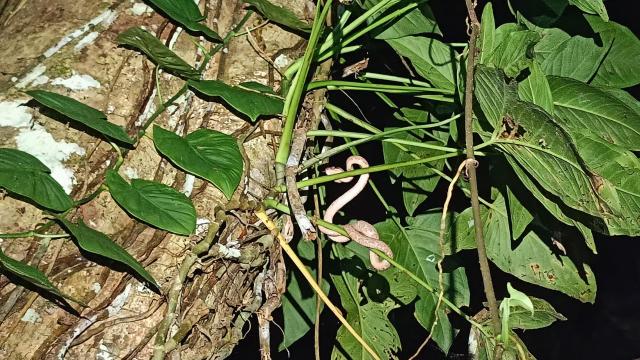
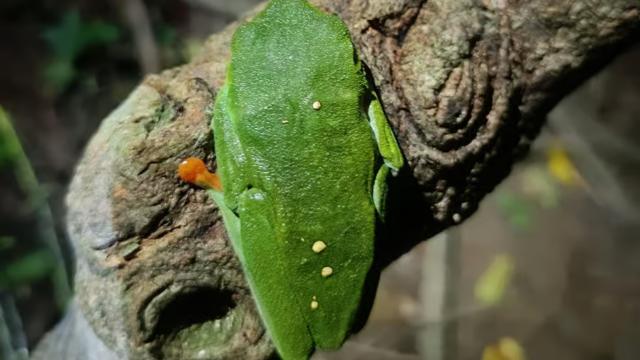
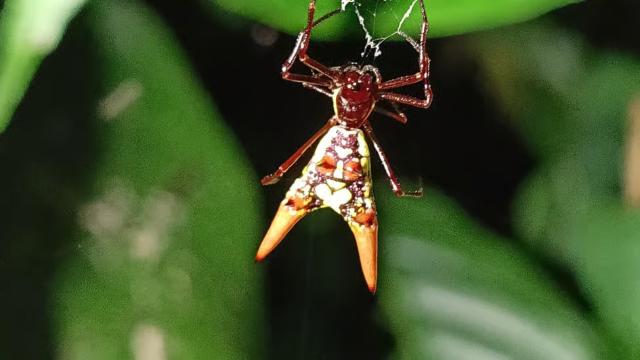
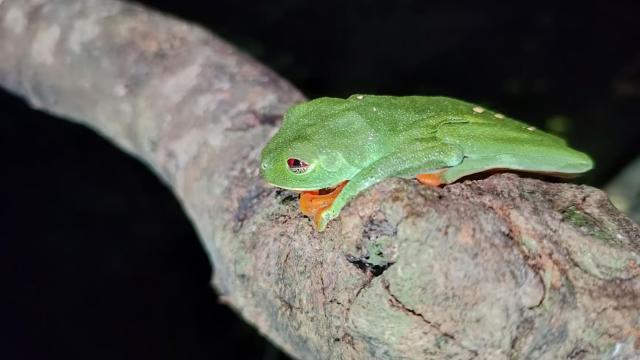
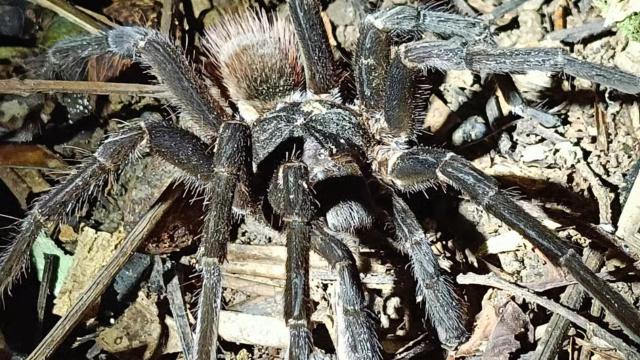
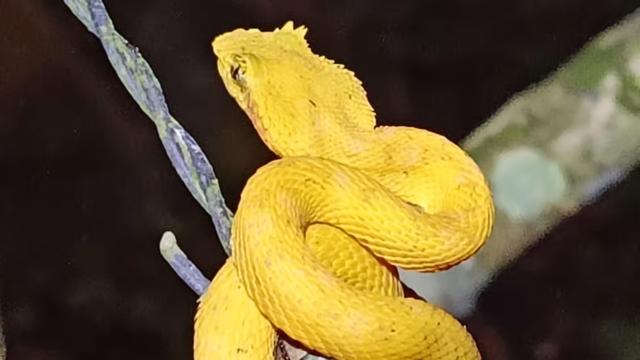
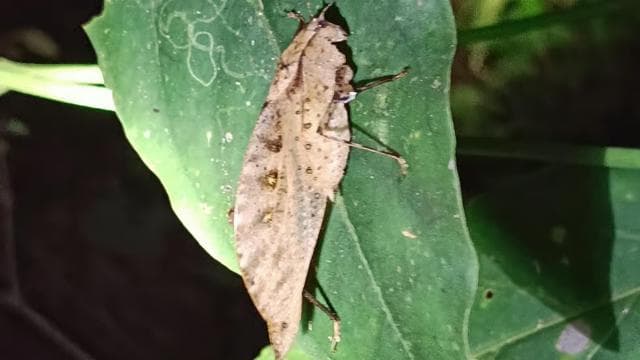
Únase a un naturalista certificado en una caminata nocturna de 2 horas en el Parque Nacional Cahuita, Costa Rica. Descubra tarántulas, ranas, serpientes, mamíferos y más en su hábitat natural en el recorrido Tarantula Way, una experiencia de vida silvestre de primer nivel bajo las estrellas.
When the sun disappears over Costa Rica’s Caribbean coast, Cahuita does not go to sleep. Instead, the rainforest begins to reveal a completely different personality—one filled with rustling leaves, distant calls, tiny movements in the darkness, glowing eyes, delicate webs, camouflaged reptiles, mysterious insects, and fascinating creatures that remain hidden during the day.
The Cahuita’s Tarantula Way Night Tour invites you to experience this extraordinary transformation firsthand.
Rather than simply visiting a rainforest, you will enter a nocturnal ecosystem where every shadow can hold a surprise. Guided by a certified naturalist, you will explore the forest after sunset while learning how Costa Rica’s remarkable wildlife survives, hunts, hides, communicates, and moves through the darkness. The experience is designed around wildlife observation, interpretation, and discovery, making it especially appealing to nature lovers, photographers, families, couples, and adventurous travelers who want to experience Cahuita beyond its beaches.
The tour currently begins around 6:00 PM at the Playa Blanca sector of Cahuita National Park and lasts approximately two hours. The experience is led by a certified naturalist guide with extensive local experience, and the tour focuses on finding nocturnal wildlife in its natural surroundings rather than presenting animals in captivity.
At first, the rainforest may appear almost completely dark.
Then you notice a sound.
A movement.
A pair of reflective eyes.
A shape on a leaf.
A spider web illuminated by a flashlight.
And suddenly, the forest feels alive in a way you may never have experienced before.
That is the magic of a Cahuita night walk.
Cahuita is one of Costa Rica’s most captivating destinations for travelers who want to combine Caribbean scenery with extraordinary biodiversity. Located on the country’s Caribbean coast, the area is famous for its lush tropical environment, beaches, coral ecosystems, rainforest, and wildlife.
During the day, visitors may explore the coastline, relax near the Caribbean Sea, hike through forest trails, or search for monkeys, sloths, birds, and other animals.
But nighttime changes everything.
Temperature, light, sound, animal behavior, and even the feeling of the forest are different after sunset.
Many creatures that remain hidden during daylight hours become active once darkness arrives. Some emerge from shelters. Others begin hunting. Frogs become easier to hear. Insects become more noticeable. Spiders may move into exposed positions. Nocturnal mammals begin searching for food, while reptiles and amphibians become part of the nighttime landscape.
The Tarantula Way Night Tour in Cahuita is designed to help travelers experience this hidden side of the ecosystem with the assistance of someone who understands where and how to look.
Instead of rushing through the forest, the experience encourages you to slow down.
Look at the leaves.
Listen to the sounds.
Watch the branches.
Examine the forest floor.
Follow the guide’s light.
The longer you stay still, the more the rainforest seems to reveal.
One of the most memorable aspects of a night wildlife tour is the sense of anticipation.
During a conventional daytime walk, visibility is relatively clear. You can see the trail, trees, plants, and surrounding landscape.
At night, your perception changes.
Your eyes become less useful.
Your ears become more important.
Your attention becomes sharper.
A small movement that you might completely ignore during the day can suddenly become the focus of your entire group.
Your guide may stop.
Everyone becomes quiet.
A flashlight moves slowly across a tree trunk.
Nothing.
Then another beam searches a nearby leaf.
Still nothing.
Suddenly, a fascinating nocturnal creature appears.
This element of surprise is part of what makes the Cahuita night experience so compelling.
The goal is not simply to walk through the forest. It is to learn how to observe a living tropical ecosystem after dark.
And because wildlife is wild, every evening is naturally different.
You may encounter tarantulas, frogs, snakes, insects, reptiles, nocturnal mammals, and other creatures, but exact sightings can never be guaranteed. That unpredictability is not a weakness—it is one of the reasons wildlife experiences are so exciting.
You never know exactly what the forest will reveal.
The name Tarantula Way immediately suggests one of the creatures visitors hope to encounter: the tarantula.
These large spiders can look intimidating, especially when illuminated against the darkness of the rainforest. Their size, hairy bodies, long legs, and slow movements create an unforgettable visual experience.
Yet tarantulas are much more than frightening-looking spiders.
They are important predators within their ecosystems and contribute to the natural balance of tropical forests. Observing one in its environment can transform fear into fascination.
Instead of simply seeing a spider, you begin to notice its physical structure.
Its legs.
Its body.
Its hairs.
Its movements.
Its relationship with the forest floor.
And the guide can help explain why the animal behaves the way it does.
This is one of the major advantages of a guided wildlife experience: you are not left trying to identify an unfamiliar creature with a quick internet search after the encounter. The guide can provide context while the animal is directly in front of you.
For travelers who have never seen a tarantula in the wild, the moment can become one of the defining memories of their Costa Rica vacation.
Although tarantulas are central to the experience, the rainforest has far more to offer.
The tour description highlights opportunities to observe a variety of nocturnal animals, including frogs, snakes, reptiles, insects, and nocturnal mammals.
This diversity is what makes the experience feel like a genuine wildlife expedition rather than a single-species attraction.
You might spend several minutes examining a tiny frog before discovering an unusual insect nearby.
A movement in the vegetation may turn out to be a reptile.
A sound overhead may draw your attention toward the trees.
A reflective pair of eyes may indicate a mammal moving quietly through the darkness.
And sometimes the smallest discovery becomes the most fascinating.
Night walks teach travelers an important lesson about tropical ecosystems: biodiversity does not always announce itself loudly.
Some of the most interesting creatures are tiny, perfectly camouflaged, or active only for a short period.
Your guide’s ability to recognize these subtle signs can make the difference between walking past an animal and actually seeing it.
Few sounds represent a tropical night as strongly as the chorus of frogs.
As daylight fades, amphibians can become much more noticeable. Their calls travel through the humid air, creating an atmosphere that feels almost cinematic.
For many travelers, hearing a frog before seeing it becomes part of the adventure.
Where is it?
In the leaves?
Near the ground?
Behind a tree?
Beside the trail?
The search itself becomes exciting.
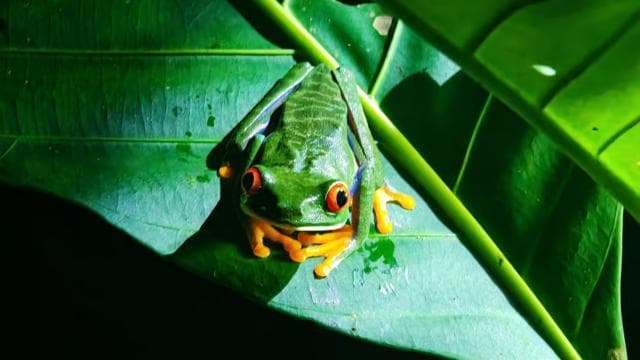
Costa Rica is famous for its amphibian diversity, and nighttime is often the ideal moment to look for these animals. Bright colors, unusual body shapes, camouflage, and fascinating behaviors can become visible when a guide carefully scans vegetation with a light.
For photographers, frogs can also provide memorable subjects.
A tiny animal sitting on a glossy leaf under a beam of light can look completely different from anything you would encounter during an ordinary daytime walk.
The nighttime forest is also an excellent environment for observing reptiles.
Snakes and lizards can become active after sunset, and some species are particularly difficult for inexperienced visitors to locate because their camouflage is exceptionally effective.
A trained naturalist knows what visual clues to look for.
A slight curve along a branch.
An unusual shape among leaves.
A movement that does not match the surrounding vegetation.
A pair of eyes reflecting light.
These details can reveal an animal that would otherwise remain invisible.
The tour description specifically highlights the possibility of seeing snakes and other reptiles alongside amphibians, insects, mammals, and other nocturnal wildlife.
For visitors who are interested in herpetology or simply curious about Costa Rica’s famous reptiles, this can be one of the most exciting aspects of the evening.
And seeing these animals in their natural habitat provides a very different experience from seeing them in a zoo or educational enclosure.
Wildlife photography at night presents a completely different challenge.
You cannot rely on broad daylight.
Instead, you work with limited illumination, contrasting shadows, close subjects, and unpredictable movement.
The darkness can actually make ordinary creatures appear extraordinary.
A spider on a leaf can become a dramatic portrait.
A frog can appear almost fluorescent against green vegetation.
A reptile partially hidden in foliage can create a striking composition.
A tiny insect can become a miniature work of art when illuminated carefully.
For photographers, the Tarantula Way Night Tour can therefore be much more than a wildlife walk. It can become an opportunity to practice observation, patience, composition, and responsible nature photography.
Even travelers without professional cameras can enjoy the experience. Modern smartphones often perform surprisingly well in low-light conditions, particularly when used carefully and without disturbing wildlife.
The most important principle is simple:
The photograph should never be more important than the animal.
A responsible wildlife experience respects distance, minimizes disturbance, and allows the animal to continue its natural behavior.
A rainforest can be overwhelming when you explore it alone.
There are thousands of plants, countless insects, complex sounds, and animals that are experts at hiding.
A knowledgeable guide turns this complexity into a story.
The Tarantula Way experience is led by a certified naturalist, with the tour information highlighting more than 17 years of experience.
That experience matters because wildlife spotting is not simply about having good eyesight.
It is about understanding patterns.
Where animals are likely to hide.
Which plants attract certain insects.
How frogs behave after rainfall.
Where spiders may be encountered.
What sounds deserve attention.
How to approach an animal without causing unnecessary disturbance.
A good naturalist does not merely point at an animal and say its name.
They help you understand it.
Why does it live here?
What does it eat?
When is it active?
How does it protect itself?
What role does it play in the ecosystem?
What makes it different from related species?
These explanations transform an evening walk into a meaningful educational experience.
The most memorable guides often teach visitors how to observe rather than simply telling them what they are seeing.
You may begin the evening looking at the forest as a wall of darkness.
After a while, you start recognizing patterns.
You learn to look under leaves.
You learn to scan tree trunks.
You learn to listen for changes in sound.
You learn that stillness can reveal movement.
You learn that an apparently empty patch of vegetation may actually be full of life.
This is one of the hidden benefits of a guided night walk.
Even after the tour ends, you may find yourself observing nature differently.
Back at your hotel, another evening walk may never feel quite the same.
You have learned to pay attention.
There is something deeply atmospheric about the Caribbean coast after dark.
The air remains warm.
Humidity hangs among the vegetation.
The forest smells of leaves, soil, moisture, and tropical plants.
The sounds of the day begin to fade.
Then the night takes over.
Instead of traffic and city noise, you may hear insects, frogs, birds, rustling vegetation, and distant animal calls.
A flashlight becomes your window into the darkness.
Every illuminated patch of forest feels like a small stage.
The beam moves.
Something appears.
The group pauses.
The guide explains.
Then the light moves again.
This rhythm creates a calm but exciting atmosphere.
It is adventurous without needing extreme physical activity.
It is educational without feeling like a classroom.
And it is immersive because you are experiencing the forest rather than simply looking at it from a distance.
A daytime wildlife tour and a nighttime wildlife tour are not simply two versions of the same activity.
They reveal different ecosystems.
During the day, sunlight makes it easier to observe birds, monkeys, sloths, butterflies, and other diurnal wildlife.
At night, the forest changes its cast of characters.
Some daytime animals disappear into shelters.
Nocturnal creatures emerge.
Insects become more active.
Amphibians become easier to hear and find.
Reptiles may move through vegetation.
Spiders become more visible.
Mammals that prefer darkness may begin searching for food.
The forest's visual identity changes as well.
Instead of seeing the entire landscape, you see small portions illuminated by your guide's light.
That limited visibility makes each discovery more meaningful.
A two-hour experience can therefore feel surprisingly rich because you are constantly shifting between observation, anticipation, learning, and discovery.
Cahuita is often associated with beautiful beaches and tropical scenery, but the region offers much more than postcard landscapes.
The Tarantula Way Night Tour encourages travelers to experience the destination through its wildlife.
You are not simply visiting Cahuita.
You are listening to it.
Watching it.
Walking through it.
Learning from it.
And experiencing one of the most important transitions in the tropical ecosystem: the movement from daylight into darkness.
This makes the tour particularly appealing to travelers who want something different from conventional sightseeing.
If you have already spent your days exploring beaches and coastal scenery, a night walk gives your trip another dimension.
If you are visiting Cahuita specifically for nature, it adds another layer to your wildlife experience.
And if you simply want a memorable evening adventure, it offers the excitement of entering the rainforest after dark.
The tour is described as suitable for adults and children who enjoy nature and adventure.
For families, a nighttime wildlife walk can be an especially engaging way to introduce children to ecology.
Instead of learning about animals only from books or screens, children can observe wildlife in the environment where it actually lives.
The experience can encourage curiosity:
“Why is the frog that color?rdquo;
“How does the spider find food?rdquo;
“Why can't we see the snake?rdquo;
“Why are these animals awake at night?rdquo;
“Where does the animal go during the day?rdquo;
These questions naturally lead into conversations about adaptation, food chains, habitats, camouflage, and conservation.
For parents, the educational element can make the experience much more meaningful than a simple sightseeing activity.
For children, however, it often just feels like an adventure.
And that combination is powerful.
For couples traveling through Costa Rica, the Tarantula Way Night Tour can also create a very different kind of evening.
Instead of spending every night at a restaurant or hotel, you can step into the rainforest together and experience something unexpected.
There is a shared excitement in searching for wildlife.
You may laugh when a harmless insect surprises you.
You may become completely silent when the guide discovers a snake.
You may stop for several minutes to watch a tiny frog.
And you may leave the forest discussing the animals you saw long after the tour ends.
These moments often become the stories couples remember most from their travels.
The experience is adventurous without requiring a high-intensity activity, making it an appealing addition to a broader Costa Rica itinerary.
For dedicated wildlife enthusiasts, Cahuita is already an attractive destination because of its rich tropical environment.
Adding a night walk allows you to explore a side of that environment that cannot be experienced during normal daytime sightseeing.
The opportunity to search for tarantulas, amphibians, reptiles, insects, and nocturnal mammals creates a broad wildlife experience rather than a single-animal excursion.
It is also an excellent complement to daytime wildlife exploration.
You can spend the morning observing one set of species and return to the forest after sunset to discover another.
This creates a more complete understanding of the ecosystem.
The same forest that looked familiar during the afternoon can seem almost completely new at night.
Nature does not operate according to a schedule designed for tourists.
That is important to understand before joining any wildlife tour.
The guide can know where animals are commonly found and understand their behavior, but no ethical wildlife operator can promise that every visitor will see every species.
Weather, temperature, rainfall, seasonal conditions, animal behavior, and natural movement all influence what appears on a particular evening.
One night may produce an incredible tarantula encounter.
Another may be dominated by frogs.
Another might provide an unexpected reptile sighting.
A different evening could bring an especially memorable encounter with a nocturnal mammal.
This unpredictability is part of the adventure.
The best mindset is not:
“Which animals am I guaranteed to see?rdquo;
Instead, think:
“What will the rainforest reveal tonight?rdquo;
That shift in perspective makes the experience more rewarding.
A meaningful rainforest experience should always begin with respect.
The animals you encounter are not performers.
They are not there for photographs.
They are living parts of a complex ecosystem.
Responsible observation means allowing wildlife to behave naturally, avoiding unnecessary contact, respecting the guide's instructions, and minimizing disturbance.
A professional naturalist helps travelers understand how to observe animals appropriately.
This is particularly important during nighttime encounters because artificial light can change the way some animals behave if used irresponsibly.
The purpose of the tour is to observe and learn—not to interfere.
That approach allows visitors to enjoy remarkable wildlife encounters while helping preserve the character of the rainforest.
A rainforest night walk is different from an ordinary city stroll.
The environment can be humid, warm, muddy, and uneven.
Good preparation can make the experience considerably more comfortable.
The tour information recommends bringing insect repellent, a flashlight or headlamp, dark-colored clothing, and comfortable walking shoes.
Dark clothing is particularly useful because it helps reduce unnecessary visual disturbance during wildlife observation.
Comfortable footwear is equally important because forest trails may contain roots, uneven surfaces, damp areas, or loose soil.
A flashlight or headlamp can help you move safely, while the guide's expertise remains central to locating wildlife.
Insect repellent is also a sensible addition in a tropical environment.
The goal is not to overpack.
It is simply to arrive prepared for the conditions.
For a tropical night walk, practical clothing is generally better than fashionable clothing.
Choose lightweight, breathable garments that allow comfortable movement.
Longer clothing can also be useful for travelers who prefer additional protection from insects and vegetation.
Dark or neutral colors are recommended for the wildlife experience.
Closed-toe walking shoes are a smart choice, especially on forest trails.
And because tropical weather can change quickly, travelers should remain prepared for the possibility of moisture or rain.
The rainforest's wet conditions are not necessarily a problem.
In fact, rainfall can sometimes make the environment even more active.
The important thing is to approach the experience with the understanding that you are entering a real tropical ecosystem—not an artificial attraction.
Perhaps the most important thing to bring is curiosity.
You do not need to be an expert in spiders.
You do not need to know the names of Costa Rica's frogs.
You do not need professional photography equipment.
You simply need to be willing to slow down and look.
The guide provides the knowledge.
The forest provides the setting.
Wildlife provides the surprises.
Together, these elements create an experience that can be both educational and exciting.
For some visitors, the highlight may be seeing their first tarantula.
For others, it may be a brilliantly colored frog.
Someone else may remember a snake hidden perfectly against a branch.
Another traveler may become fascinated by an insect they had never seen before.
There is no single definition of the perfect night walk.
The forest decides what story you take home.
Travel is often about seeing famous places.
But the most memorable experiences frequently come from seeing familiar places differently.
You may already know that Costa Rica is famous for biodiversity.
You may have seen photographs of tropical forests.
You may have visited a national park during daylight.
But walking through a rainforest at night gives you a completely different perspective.
You begin to understand that the forest is not merely a collection of trees.
It is a living network.
Creatures move through different layers.
Predators search for prey.
Insects interact with plants.
Amphibians emerge with changing conditions.
Reptiles use camouflage.
Spiders occupy their own ecological niches.
Mammals navigate through darkness.
Everything is connected.
The Tarantula Way Night Tour allows travelers to witness a small part of that hidden system.
There is also an emotional quality to exploring the forest after sunset.
Darkness naturally creates uncertainty.
You cannot see everything.
You cannot predict what will happen next.
That uncertainty makes even small discoveries exciting.
A tiny spider can stop an entire group.
A frog hidden among leaves can become the evening's star.
A movement in the trees can create immediate curiosity.
For a few hours, modern life becomes less important.
Phones are used mainly as cameras.
Conversation becomes quieter.
Attention moves toward the natural world.
Instead of checking notifications or watching the clock, you are waiting for the guide to discover what is hiding nearby.
This kind of immersion can feel surprisingly refreshing.
One of the advantages of the Tarantula Way Night Tour is that it transforms an evening into an experience.
You do not need to dedicate an entire day to it.
The activity begins around sunset, when the transition from day to night creates the perfect atmosphere for nocturnal exploration.
That means travelers can enjoy other activities during the day and then return to nature in the evening.
It is a particularly attractive option for visitors who want to maximize their time in Cahuita.
Rather than treating nighttime as downtime, you can use it to discover another side of the destination.
And after approximately two hours in the forest, you can leave with an entirely different appreciation for the wildlife around you.
Cahuita offers travelers an exceptional opportunity to combine coastal relaxation with nature-based exploration.
A daytime visit can introduce you to the landscape.
A beach experience can connect you with the Caribbean coast.
A wildlife hike can reveal the forest during daylight.
And a night walk can show you what happens after sunset.
The Tarantula Way experience therefore fits naturally into a broader nature-focused Costa Rica vacation.
It adds variety without requiring an entirely separate destination.
For travelers who are fascinated by biodiversity, this can be especially valuable because it allows you to experience different activity periods within the same tropical environment.
Wildlife encounters are exciting, but the quality of interpretation can determine how much you take away from the experience.
A knowledgeable guide can transform an animal sighting into a story.
Instead of simply seeing a tarantula, you learn about its ecological role.
Instead of simply seeing a frog, you understand why it is active at night.
Instead of simply noticing a snake, you learn how camouflage and behavior help it survive.
The Tarantula Way tour specifically emphasizes certified naturalist guidance and extensive experience, giving travelers an educational component alongside the wildlife search.
This is particularly valuable for visitors who want more than photographs.
You leave with knowledge.
And knowledge can make the entire landscape feel more alive.
The Cahuita Tarantula Way Night Tour is particularly well suited to travelers who enjoy:
You do not have to consider yourself an expert wildlife enthusiast.
Curiosity is enough.
In fact, first-time wildlife travelers may find the experience especially memorable because the forest introduces them to creatures they may never encounter at home.
Some travelers want to spend their vacations checking famous landmarks off a list.
Others want to understand a destination.
If you belong to the second group, a guided night walk can be particularly rewarding.
You are not simply visiting Cahuita.
You are learning how the ecosystem works.
You are discovering what happens after dark.
You are meeting animals most visitors might never notice.
You are hearing stories about survival and adaptation.
And you are experiencing the rainforest through the perspective of someone who knows it intimately.
That is what transforms a simple walk into a travel memory.
The best wildlife experiences are rarely predictable.
You might arrive hoping to see a tarantula and leave fascinated by a frog.
You might expect reptiles and become obsessed with insects.
You might come for photography and leave with a new appreciation for tropical ecology.
You might think the forest is quiet and discover that it is actually full of sound.
The important thing is to remain open.
The rainforest has its own schedule.
Its own rhythm.
Its own surprises.
The guide can help you find the clues, but nature decides what appears.
And that is exactly why the experience feels authentic.
Cahuita National Park is not simply beautiful.
It is alive.
During daylight, its tropical environment provides one kind of experience.
After sunset, the atmosphere changes dramatically.
The Tarantula Way Night Tour gives travelers the opportunity to enter this nocturnal world with the support of an experienced naturalist guide.
Over approximately two hours, you can explore the forest, search for tarantulas and other wildlife, listen to the sounds of the night, and learn about the remarkable creatures that share this ecosystem.
It is a chance to slow down.
To look closer.
To listen.
To become curious again.
And to discover that some of Costa Rica's most fascinating wildlife experiences begin when the sun goes down.
Years after a Costa Rica vacation, travelers often remember specific moments rather than entire days.
The first time they saw a sloth.
The sound of the rainforest.
The color of the Caribbean water.
A sudden tropical rain shower.
A monkey moving through the trees.
Or the moment a guide illuminated a tarantula hidden in the darkness.
The Cahuita’s Tarantula Way Night Tour is designed around those kinds of moments.
It is not about rushing from one attraction to another.
It is about discovery.
It is about anticipation.
It is about the excitement of seeing something that was invisible only seconds earlier.
And it is about sharing that moment with people who are just as curious as you are.
A night walk is not only visual.
It engages every sense.
You hear frogs calling from somewhere beyond the trail.
You hear insects moving through leaves.
You feel the warm tropical air.
You smell wet vegetation and forest soil.
You see a narrow beam of light moving across the darkness.
And occasionally, you discover something extraordinary.
This sensory experience makes the rainforest feel much more immersive than a standard sightseeing excursion.
You are not observing nature from behind glass.
You are walking through it.
That difference is difficult to explain until you experience it yourself.
One of the most valuable lessons a naturalist can teach is that wildlife is often closer than you think.
A forest does not need to contain dramatic animals to be fascinating.
Sometimes the most interesting discovery is only a few centimeters long.
A tiny insect can reveal incredible patterns.
A spider can display complex structures.
A frog can demonstrate extraordinary camouflage.
A leaf can become home to an entire miniature ecosystem.
Once you begin looking closely, the rainforest seems to expand.
There is more to discover than you initially realized.
That is one of the reasons a guided night walk can remain fascinating even during quiet moments.
You are learning how to see.
The Cahuita Tarantula Way Night Tour brings together several experiences in one evening:
Wildlife observation.
Rainforest exploration.
Naturalist interpretation.
Photography opportunities.
Educational discovery.
Adventure.
And perhaps most importantly, the feeling of entering a world that most travelers never see.
The tour is currently offered from approximately $50 per person, according to the Booking Adventures product page, although travelers should confirm the current price and availability when making a reservation.
The experience also includes a certified naturalist/wildlife guide and insurance during the tour according to the listed inclusions.
With its combination of expert guidance, nighttime exploration, and the possibility of encountering fascinating tropical wildlife, the tour offers a distinctive way to experience the Caribbean side of Costa Rica.
Imagine standing at the edge of the rainforest as daylight begins to disappear.
The last traces of sunlight filter through the trees.
The temperature changes.
The sounds become different.
Your guide prepares you for the walk.
You switch on your flashlight.
The forest ahead is dark.
You take the first step.
Then another.
For a while, nothing seems to happen.
Then your guide stops.
The flashlight moves toward a leaf.
Everyone looks.
And there it is.
A creature that was completely invisible moments ago.
This is what makes a night walk special.
The rainforest does not give everything away immediately.
You have to pay attention.
You have to wait.
You have to look.
And when the forest finally reveals one of its secrets, the moment feels earned.
Costa Rica is famous around the world for its natural beauty and biodiversity, but seeing the country after dark provides an entirely new perspective.
The Cahuita’s Tarantula Way Night Tour offers an immersive opportunity to explore that hidden world.
From tarantulas and frogs to reptiles, insects, mammals, and other nocturnal creatures, every evening brings the possibility of discovery.
Whether you are traveling with family, exploring Costa Rica as a couple, photographing wildlife, or simply looking for an unusual adventure, this experience can add something genuinely different to your journey.
Come prepared to walk.
Come prepared to listen.
Come prepared to learn.
Most importantly, come prepared to be surprised.
Because when darkness settles over Cahuita, the rainforest is only beginning its nightly performance.
Join the Cahuita’s Tarantula Way Night Tour and discover the wild, mysterious, and unforgettable side of Costa Rica that comes alive after sunset.
The second part below continues the destination-focused storytelling from Part 1 and moves into the practical, itinerary, booking, trust, and conversion sections. The tour page confirms a 2-hour experience beginning around 6:00 PM at the Playa Blanca entrance of Cahuita National Park, with a certified naturalist/wildlife guide and tour insurance included. The listed starting price is $50 per person.
As the Caribbean afternoon gradually gives way to evening, make your way toward the Playa Blanca entrance of Cahuita National Park. The tour is scheduled to begin at approximately 6:00 PM, giving you the opportunity to experience the forest during the fascinating transition from daylight to darkness.
This is when Cahuita begins to change.
The familiar tropical landscape becomes quieter. Shadows stretch between the trees. The last daylight disappears through the canopy, and the forest begins revealing a different collection of inhabitants.
Your Cahuita Tarantula Way Night Tour begins at precisely this magical moment.
Before entering the forest, take a moment to prepare yourself mentally for the experience. This is not a conventional sightseeing tour where everything is visible from the beginning. Instead, it is an exploration based on patience, observation, and the expertise of your naturalist guide.
Your guide will help you understand how to move through the rainforest responsibly and how to look for animals without disturbing them.
Then the search begins.
Your evening begins at the Playa Blanca entrance of Cahuita National Park, around 6:00 PM.
This meeting point places you directly at the gateway to the forest environment that will become your nighttime adventure.
If your booking includes a separately arranged pickup or meeting-point instruction, the tour operator advises that guests receive confirmation of the exact arrangements before the experience.
Arrive prepared with your walking shoes, insect repellent, dark-colored clothing, and flashlight or headlamp.
Once everyone is ready, your guide can introduce the evening's experience and prepare the group for the rainforest walk.
One of the most beautiful parts of this experience is that the forest does not suddenly become nighttime.
Instead, you experience the transition.
At first, there may still be traces of natural light filtering through the trees.
Then the forest becomes progressively darker.
Sounds that seemed insignificant earlier become easier to notice.
The atmosphere changes.
Your eyes adjust.
And the guide begins searching for the first signs of nocturnal activity.
This gradual transition makes the experience feel like an actual expedition rather than simply entering a dark trail.
You are watching an ecosystem change in real time.
The tour is guided by a certified naturalist, and the product information highlights guides with more than 17 years of experience.
That expertise becomes particularly valuable at night.
In darkness, spotting wildlife is significantly more difficult for inexperienced visitors.
A professional naturalist knows where to look and what clues to notice.
A movement in a leaf.
A silhouette on a branch.
A reflective eye.
An unusual shape.
A web stretched between vegetation.
A sound coming from somewhere in the canopy.
The guide can interpret these clues and help transform them into wildlife encounters.
Rather than walking quickly through the forest, the experience is about slowing down and examining your surroundings.
The signature experience of Tarantula Way is, naturally, the search for tarantulas.
These impressive spiders are among the rainforest's most fascinating nocturnal residents.
For visitors who have only encountered tarantulas in photographs, seeing one in the wild can be surprisingly memorable.
The guide can help you observe the spider while explaining its behavior, habitat, and role in the ecosystem.
You may notice how the tarantula moves.
You may observe its body structure and characteristic hairs.
You may discover how well it blends into the forest environment.
And you may realize that an animal that initially seemed frightening is actually an important component of the tropical food web.
The objective is not simply to find a large spider.
It is to understand the creature.
That is what makes the encounter educational as well as exciting.
Although tarantulas are the namesake of the tour, they are only one part of the nighttime ecosystem.
The official tour description specifically mentions opportunities to encounter frogs, snakes, reptiles, insects, and nocturnal mammals.
This variety means that every section of the trail can offer something different.
Your guide may scan vegetation for frogs.
A tree trunk might reveal a camouflaged reptile.
A branch could contain a spider.
The forest floor may hide insects.
And deeper among the vegetation, you may hear or see a nocturnal mammal.
The diversity keeps the experience unpredictable.
You never know what the next beam of light will reveal.
Frogs become an important part of the nighttime rainforest experience.
Their calls can help reveal where they are hiding, and experienced guides can use both sound and visual clues to locate them.
Some may be sitting on leaves.
Others may remain close to the ground.
Some can be remarkably well camouflaged.
Others may stand out because of their colors or patterns.
Your guide can explain the role amphibians play in tropical ecosystems and why nighttime is such an important period for many frog species.
For children, this can become one of the most exciting parts of the walk.
For photographers, frogs can provide beautiful subjects.
And for wildlife enthusiasts, even a small frog can become a fascinating biological discovery.
The nighttime rainforest is also home to reptiles that can be difficult to locate during daylight.
The tour page notes that travelers may encounter snakes and reptiles, with visitor reviews specifically mentioning sightings such as the eyelash viper.
Seeing a snake in the forest can create one of the evening's most memorable moments.
The key is to let the guide control the encounter.
Never attempt to approach, touch, move, or photograph wildlife in a way that causes disturbance.
Instead, remain at the appropriate distance and listen to the guide.
A skilled naturalist can explain how camouflage, movement, hunting behavior, and environmental adaptation allow these animals to survive in the rainforest.
What may initially look like a simple snake sighting can therefore become an unforgettable natural-history lesson.
One of the biggest mistakes visitors can make on a rainforest walk is focusing only on large animals.
The smaller creatures are everywhere.
Insects.
Spiders.
Tiny amphibians.
Other invertebrates.
They may be small, but they are essential to the functioning of the ecosystem.
At night, many insects become particularly active, making the forest feel alive with movement.
Your guide can help you notice details that you might otherwise miss.
A leaf may contain an insect.
A tree trunk may reveal a perfectly camouflaged creature.
A web may indicate that a spider is nearby.
The deeper you look, the more life you begin to see.
This is one of the most valuable lessons of the Tarantula Way experience: wildlife is not always obvious, but it is often closer than you think.
The tour also offers the possibility of spotting shy mammals that become active after dark.
Mammal sightings can be particularly exciting because these animals may move quietly through the forest and disappear quickly.
You may hear movement before you see anything.
The guide may pause.
The group becomes silent.
A flashlight moves carefully through the vegetation.
For a few seconds, everyone waits.
Then an animal may appear.
Or it may disappear before everyone gets a clear look.
That uncertainty is part of genuine wildlife watching.
The rainforest does not guarantee perfect photographic opportunities.
It offers something more authentic: the chance to witness animals behaving naturally.
The Tarantula Way Night Tour lasts approximately two hours.
Two hours might sound short until you experience a rainforest at night.
The pace is naturally slower than a conventional hike because the objective is not simply to cover distance.
The goal is to find wildlife.
You may stop frequently.
You may spend several minutes observing one animal.
The guide may explain a particular species or ecological behavior.
The group may pause to listen.
You may move only a short distance and still encounter several fascinating creatures.
This makes the tour suitable for travelers who prefer immersive experiences rather than physically demanding adventures.
Walking through a tropical forest alone at night is very different from exploring it with an experienced naturalist.
Without a guide, many animals would probably remain invisible.
You might walk directly past a tarantula without noticing.
A frog could sit only a few feet away.
A reptile could blend into vegetation.
An insect could remain hidden in plain sight.
The naturalist's experience changes what you are able to see.
The guide uses knowledge of animal behavior and habitat to direct the group's attention.
This is why the official tour description emphasizes certified naturalist guides with more than 17 years of experience.
For travelers interested in nature, that knowledge can be one of the most valuable parts of the tour.
The experience is not limited to identifying species.
The guide also explains behavior, habitat, and nighttime survival strategies.
This makes the tour particularly rewarding for curious travelers.
Consider a tarantula.
Instead of merely knowing its name, you can begin to understand how it survives.
Consider a frog.
Why does it become active after dark?
Consider a snake.
How does it find prey?
Consider an insect.
Why does it occupy a particular part of the forest?
Every animal has a story.
And every story is connected to the wider rainforest ecosystem.
Costa Rica's Caribbean coast is warm and humid, so practical preparation is important.
The tour specifically recommends:
These simple items can make your experience much more comfortable.
A good pair of walking shoes is especially important because rainforest trails can be uneven.
Dark clothing is specifically recommended for this experience because it helps reduce unnecessary disturbance during wildlife observation.
Bright colors are not necessary for a nighttime forest walk.
Neutral or dark clothing is practical and appropriate.
It can also make photography more comfortable because bright clothing can reflect light when your group is using flashlights.
Insects are a natural part of a tropical rainforest.
That is exactly why insect repellent is one of the recommended items.
Apply it before entering the forest and reapply as appropriate for the conditions and product instructions.
Remember that the presence of insects is not a sign that something is wrong with the tour.
You are entering their habitat.
For many wildlife enthusiasts, insects are actually among the most fascinating discoveries of the night.
The official tour information recommends bringing a flashlight or headlamp.
A headlamp can be particularly convenient because it leaves your hands free.
A handheld flashlight, meanwhile, can make it easier to direct light where needed.
Whatever you use, follow the guide's instructions.
The purpose of the light is to improve safety and wildlife observation—not to repeatedly shine intense light directly into animals' eyes.
Night photography can be challenging, but it can also be incredibly rewarding.
If you bring your camera or smartphone, consider these simple principles.
Wildlife can appear suddenly.
Avoid keeping your camera buried deep inside your backpack.
Have it accessible before entering the forest.
Follow your guide's recommendations regarding flash photography.
The welfare of the animal should always come before getting a perfect photograph.
Do not spend the entire two hours looking at a screen.
Sometimes the best memory is the moment you experienced directly.
Take photographs when appropriate, then put the camera down and watch.
Night photography often requires patience.
Wait for the animal to settle.
Avoid chasing it for a better angle.
Allow the guide to manage the encounter.
The product describes the experience as a peaceful walk along forest trails lasting approximately two hours.
It is therefore better understood as a guided wildlife walk rather than an extreme hiking expedition.
However, travelers should still be prepared for natural outdoor conditions.
You will be walking in a tropical environment after dark.
Trails may be uneven.
Humidity can make the experience feel warmer.
Walking shoes are recommended.
If you have mobility concerns or specific physical requirements, it is sensible to discuss them with the tour operator before booking so that the experience can be evaluated according to your individual needs.
Yes. The official description states that the experience is suitable for adults and children who love nature and adventure.
For families, the tour can turn a vacation evening into an interactive nature lesson.
Children can learn that wildlife is not limited to large, famous animals.
They can discover insects, frogs, spiders, reptiles, and other creatures that they may never have seen before.
Parents can encourage children to ask questions about:
The result is entertainment combined with education.
Absolutely.
For couples visiting Costa Rica, the tour offers an unusual alternative to a typical evening.
Instead of simply watching the sunset or dining at a restaurant, you can explore a tropical rainforest together after dark.
The shared anticipation creates a memorable atmosphere.
You never know what the guide will discover next.
A tarantula.
A colorful frog.
A hidden reptile.
A nocturnal mammal.
Or an unexpected creature that becomes the story you tell after returning home.
This experience is particularly attractive to wildlife lovers.
The official description specifically positions it for wildlife lovers, nature photographers, and travelers seeking a unique rainforest experience.
If biodiversity is one of the reasons you are visiting Costa Rica, adding a night walk to your itinerary gives you a broader view of the country's ecosystems.
Instead of only searching for daytime animals, you can experience the nocturnal side of the forest as well.
The official product page currently lists two primary inclusions:
A certified naturalist leads the experience and helps identify wildlife while explaining behavior and habitat.
Insurance during the tour is also listed as included.
These inclusions make the experience more straightforward because you are not simply entering the forest independently.
You have professional guidance throughout the activity.
The current product information does not list meals, drinks, transportation, professional photography, or personal equipment as standard inclusions.
Travelers should therefore avoid assuming that these items are included unless their individual reservation confirms otherwise.
The safest approach is to check the booking details for the exact meeting-point or pickup arrangements and any special requirements before the tour date.
The tour page currently lists the experience from $50 per person.
Prices can change depending on booking conditions, dates, availability, or platform updates, so travelers should confirm the current price at the time of reservation.
For a two-hour guided wildlife experience with a certified naturalist and tour insurance included, it can be an attractive addition to a Costa Rica itinerary for travelers who prioritize authentic nature experiences.
Booking a wildlife experience is not only about selecting a date.
It is also about making sure your contact information is accurate.
The tour operator states that, after reservation, the team will contact guests one day before the tour to confirm the exact hotel/Airbnb pickup time or meeting point.
If you selected a meeting point during booking, the reservation is considered confirmed and you should arrive at the selected location at the scheduled time.
Make sure the phone number, WhatsApp contact, or email entered during booking is correct.
This allows the team to communicate important updates smoothly.
Rain is part of life in a tropical rainforest.
Weather can change quickly, particularly in humid Caribbean environments.
The booking information specifically encourages travelers to contact the tour team for weather questions or special requests.
Rather than making assumptions about whether an evening tour will operate, contact the operator if conditions are uncertain.
This is especially important when your Costa Rica itinerary includes multiple activities and transportation arrangements.
There are several important advantages.
An experienced guide can notice animals that most visitors would miss.
The guide understands the environment and can explain what you are seeing.
You learn about animal behavior and habitats instead of simply taking photographs.
Walking with a knowledgeable guide can make nighttime exploration feel more comfortable.
A professional guide can help the group observe wildlife without unnecessary disturbance.
Instead of simply walking through the forest, you become an active participant in discovering its hidden life.
Experience a rainforest environment that most daytime visitors never see.
Discover one of the most iconic nocturnal creatures associated with the tour.
Search for frogs, snakes, reptiles, insects, and nocturnal mammals.
The product highlights certified guides with more than 17 years of experience.
The duration is long enough to immerse yourself in the environment without taking an entire day from your itinerary.
The tour is described as suitable for adults and children interested in nature and adventure.
Learn about nocturnal behavior while actively searching for wildlife.
Cahuita combines Caribbean atmosphere with tropical forest and protected natural environments.
That combination makes it an excellent destination for travelers who do not want to choose between beach relaxation and wildlife exploration.
You can spend your day enjoying the coast.
Then, when evening arrives, shift your attention toward the forest.
This combination makes Cahuita especially attractive for travelers who want variety.
The Tarantula Way Night Tour adds another dimension to the destination by allowing you to explore after dark.
Costa Rica's biodiversity is often discussed in terms of statistics and species lists.
But travelers understand biodiversity differently when they experience it directly.
Seeing a tarantula move across the forest floor makes the idea of tropical biodiversity real.
Hearing frogs calling from several directions makes the ecosystem feel alive.
Watching a snake remain perfectly camouflaged teaches you something about adaptation that no textbook photograph can fully communicate.
That is the value of responsible nature tourism.
It turns knowledge into experience.
A memorable Costa Rica vacation does not have to be a checklist.
Instead of asking only:
“What places should I visit?rdquo;
ask:
“What experiences do I want to remember?rdquo;
The Tarantula Way Night Tour can become one of those experiences.
It is not just “another tour.”
It is an evening of discovery.
An opportunity to learn.
A chance to see creatures that most travelers never notice.
And a reminder that the natural world continues long after sunset.
One of the most important lessons for first-time wildlife travelers is patience.
There may be quiet periods.
You may walk for several minutes without seeing anything obvious.
Do not assume that nothing is happening.
Your guide may be listening.
Looking.
Searching.
Following clues.
Then suddenly, everything changes.
That is wildlife watching.
The excitement comes from the possibility of discovery.
The official tour reviews reflect this appeal, with travelers praising the guides' ability to locate animals that visitors might otherwise miss and describing the experience as immersive and educational.
Imagine returning to your accommodation after the tour.
Someone asks:
“How was your evening?rdquo;
You could say you went to dinner.
Or you could say:
“We walked through a rainforest after dark and saw a tarantula, frogs, and a snake with our naturalist guide.”
That is the kind of travel memory that stays with you.
The best experiences are often the ones that give you stories.
The Tarantula Way Night Tour is built around exactly that kind of discovery.
Today's travelers increasingly want experiences that connect them with nature without treating wildlife as entertainment.
The Tarantula Way format encourages observation in the animals' natural environment.
You walk through their habitat.
You observe.
You learn.
You leave.
The animals continue their lives.
That relationship between tourism and conservation is important.
A good wildlife encounter should leave you more interested in protecting the environment—not simply more interested in getting a photograph.
From the moment you arrive near the Playa Blanca entrance to the final moments of the forest walk, the experience follows a simple but compelling rhythm:
Meet.
Prepare.
Enter the forest.
Listen.
Search.
Discover.
Learn.
Observe.
Remember.
Approximately two hours later, you emerge with a new perspective on Cahuita.
The forest that looked mysterious at the beginning of the evening is no longer quite so unfamiliar.
You have learned how to look.
You have learned how to listen.
And you have seen the hidden world that appears when the sun disappears.
Yes, if you are curious rather than completely uncomfortable around spiders.
The tour is about observing wildlife, not touching it.
However, if spiders or other wildlife cause significant anxiety, consider whether a nighttime rainforest environment is the right experience for you.
No advanced hiking experience is indicated by the product description. The experience is described as a peaceful forest walk of approximately two hours.
Comfortable walking shoes are recommended.
No.
A camera or smartphone is optional.
The experience is primarily about wildlife observation and learning.
The tour description states that it is suitable for adults and children who enjoy nature and adventure.
Parents should consider each child's comfort with nighttime walking, insects, darkness, and wildlife.
No ethical wildlife experience can guarantee exact sightings.
Animals are wild and their behavior changes according to natural conditions.
The tour provides expert guidance to increase the likelihood of spotting wildlife.
To get the greatest value from your experience, approach the tour with realistic expectations.
Do not judge the success of the evening solely by how many species you photograph.
Instead, pay attention to what you learn.
Listen to the guide.
Observe animal behavior.
Notice the sounds of the forest.
Watch how your perception changes as your eyes adjust to darkness.
Allow yourself to be surprised.
The rainforest has far more to offer than a checklist of animals.
There is something unforgettable about entering a tropical rainforest just as the sun disappears.
The daytime world fades.
The nocturnal world emerges.
And suddenly, the smallest movement becomes fascinating.
A spider.
A frog.
A snake.
An insect.
A mammal moving quietly through the trees.
Each discovery is a reminder that the forest is never truly still.
The Cahuita’s Tarantula Way Night Tour gives you the opportunity to experience this hidden world with the assistance of an experienced naturalist guide.
The tour begins around 6:00 PM, lasts approximately two hours, and currently starts from $50 per person. A certified naturalist/wildlife guide and insurance during the tour are listed as included.
Bring your insect repellent.
Bring comfortable walking shoes.
Bring a flashlight or headlamp.
Wear dark clothing.
And most importantly, bring your curiosity.
Because once darkness falls over Cahuita, the forest begins telling a completely different story.
If your Costa Rica itinerary includes Cahuita and you want to experience more than beaches and daytime sightseeing, this guided nighttime wildlife adventure deserves a place on your itinerary.
Explore the rainforest after dark.
Search for tarantulas.
Listen for frogs.
Look for reptiles.
Watch for nocturnal mammals.
Discover insects and other fascinating creatures.
Learn from a certified naturalist.
And experience the Caribbean rainforest at the time when many of its most intriguing residents become active.
The official tour page currently lists the experience from $50 per person and provides booking and contact instructions for arranging your meeting point or pickup details.
Your Costa Rica adventure does not have to end when the sun goes down.
In Cahuita, that may be when the most fascinating part is just beginning.
The FAQ section below is designed to capture both transactional and informational long-tail searches while answering the practical questions travelers are most likely to have before booking the Cahuita’s Tarantula Way Night Tour. The answers are based on the current product information, including the approximately 2-hour duration, 6:00 PM start around the Playa Blanca entrance, certified naturalist guide, wildlife focus, required items, and booking procedure.
The Cahuita Tarantula Way Night Tour is a guided evening rainforest experience in Cahuita, Costa Rica. It takes travelers into the rainforest after sunset to search for nocturnal wildlife with the help of an experienced certified naturalist guide.
Tarantulas are one of the main attractions, but the experience also focuses on frogs, snakes, reptiles, insects, and nocturnal mammals. The guide helps participants identify wildlife and explains animal behavior, habitat, and nighttime survival strategies.
The Tarantula Way Night Tour lasts approximately 2 hours.
The adventure begins around 6:00 PM, when the transition from daylight to darkness creates the ideal atmosphere for exploring the rainforest and looking for nocturnal species.
The tour begins at the Playa Blanca entrance of Cahuita National Park, with the published tour information indicating an approximate starting time of 6:00 PM.
Depending on the reservation arrangements, the tour team can also confirm the appropriate pickup time or meeting point with guests before the experience.
The tour is designed around nocturnal wildlife, so travelers may encounter a variety of species that become active after sunset.
Possible sightings include:
The tour description specifically mentions sightings such as colorful frogs, snakes including eyelash vipers, tarantulas, and playful nocturnal mammals.
Because wildlife is naturally unpredictable, specific animal sightings cannot be guaranteed.
Tarantulas are a central focus of the experience, but no wildlife tour can responsibly guarantee a specific animal sighting.
Animal activity depends on natural factors such as weather, season, habitat conditions, and animal behavior. The major advantage of joining this guided experience is having a knowledgeable naturalist who knows how to search for hidden nocturnal species.
The product information emphasizes the guide's ability to locate animals that travelers might otherwise miss.
Yes. The tour information states that the experience is suitable for adults and children who enjoy nature and adventure.
Parents should consider that this is an evening rainforest walk, so children should be comfortable walking outdoors after dark and following the guide's instructions.
Comfortable walking shoes, insect repellent, a flashlight or headlamp, and dark-colored clothing are recommended.
Yes. The experience is particularly appealing to nature photographers and wildlife enthusiasts because the focus is on finding animals in their natural nighttime environment.
Photography opportunities will naturally depend on what wildlife appears and the lighting conditions. A flashlight or headlamp is recommended as part of the preparation for the tour.
For photographers, the most important approach is patience. Instead of expecting constant action, be prepared to stop, observe, listen, and wait for the guide to locate interesting wildlife.
The tour recommends wearing dark-colored clothing.
Dark clothing is encouraged to help avoid unnecessarily disturbing wildlife during the nighttime walk. Travelers should also wear comfortable walking shoes suitable for forest trails.
A practical outfit includes:
The official tour information recommends bringing:
These items help make the experience more comfortable and support responsible wildlife observation.
Yes, insect repellent is specifically recommended.
Because the experience takes place in a tropical rainforest after dark, travelers should be prepared for insects and other natural elements. Bringing repellent can make the approximately two-hour walk much more comfortable.
The experience is a guided rainforest walk of approximately two hours, rather than a high-intensity adventure activity.
Travelers should be comfortable walking along forest trails at night and should wear appropriate walking shoes. If you have concerns about mobility or specific physical requirements, it is best to contact the tour operator before booking.
Yes. The tour includes a certified naturalist/wildlife guide, and the product description states that the guides have more than 17 years of experience.
The guide's role is especially important during a night walk because many rainforest animals are difficult for inexperienced visitors to locate. The guide helps identify wildlife and explains its behavior, habitat, and nighttime survival strategies.
The published inclusions are:
Other practical items, such as insect repellent and a flashlight or headlamp, are listed under What to Bring, so travelers should prepare those themselves unless otherwise confirmed during booking.
The current GoBookingAdventures product page lists the tour from $50 per person.
Because tour pricing can change based on booking conditions, travelers should check the live booking page for the current price and available options before completing their reservation.
The tour can be booked through the product's booking option on GoBookingAdventures.
After making a reservation, the team states that they will contact the traveler one day before the tour to confirm the exact hotel/Airbnb pickup time or meeting point.
If a meeting point was already selected during booking, the reservation is considered confirmed and travelers should arrive at that location at the scheduled time.
The tour team contacts guests one day before the experience to confirm the exact arrangements.
Travelers should make sure the WhatsApp number, phone number, or email address entered during booking is accurate, so the team can communicate successfully.
Guests can also contact the team regarding reservation changes, weather questions, or special requests.
Yes. The tour is a strong option for couples looking for something different from a traditional daytime sightseeing activity.
Exploring a tropical rainforest after sunset creates a quieter, more mysterious atmosphere, while searching together for tarantulas, frogs, reptiles, and other nocturnal creatures adds an element of discovery.
The tour's own guest information specifically notes that the experience appeals to couples as well as families and nature enthusiasts.
A guided night walk offers an important advantage: trained local wildlife knowledge.
Many nocturnal animals are difficult to locate because they are camouflaged, hidden among vegetation, or active in places that casual visitors may overlook.
The certified naturalist guide knows what to look for and can explain what you are seeing while helping the group observe wildlife responsibly. The product description specifically highlights the guide's tracking skills and ability to find hidden species.
No. Although tarantulas are a major attraction, the tour is designed as a broader nocturnal rainforest wildlife experience.
Participants may also search for frogs, snakes, reptiles, insects, nocturnal mammals, and other creatures that become active after sunset.
That variety is what makes the experience appealing even to travelers who are interested in Costa Rican wildlife generally rather than tarantulas specifically.
A night tour offers travelers a completely different perspective of the rainforest.
During daylight, visitors may focus on birds, monkeys, sloths, tropical plants, and scenery. After sunset, another layer of the ecosystem becomes active.
The Cahuita Tarantula Way Night Tour provides approximately two hours to explore that nighttime environment with a certified naturalist, search for tarantulas and other nocturnal animals, and learn about the behavior and survival strategies of creatures that are rarely noticed during a daytime visit.
Después de completar su reserva, nuestro equipo se comunicará con usted un día antes de su recorrido para confirmar la hora exacta de recogida en su hotel / Airbnb o el punto de encuentro.
Si seleccionó un punto de encuentro durante su reserva, tenga en cuenta que su reserva está completamente confirmada; simplemente llegue al lugar elegido a la hora programada.
Asegúrese de que el número de WhatsApp, el número de teléfono o el correo electrónico que ingresó durante la reserva sean correctos para que podamos comunicarnos con usted sin problemas.
Para cualquier cambio en su reserva, preguntas sobre el clima o solicitudes especiales, no dude en contactarnos:
¡Esperamos darle la bienvenida! 🌴✨